Maps are fun, so I vibe-code my own Google maps

So last year I started vibe coding. This adventure started around October or November; now I cannot possibly remember, because it oddly feels like a lifetime ago. My first testing ground was tools like Figma Make and Lovable. Those two tools are very friendly setups: Figma Make is obviously built with UX professionals in mind; you can start with a prompt or a design, and it builds a very neat prototype. With Lovable, I started with prompts, and in my opinion, of the two tools, Lovable always gave me superior output, particularly in UI quality, which is funny because Figma is a tool oriented toward authoring UIs…Most of these projects were me evaluating these tools for work purposes, thinking how, as a product manager, I can convey the problem, the vision and sometimes even the flow better.
By early 2026, the options for vibe coding will keep increasing, as did MCPs. Every week is a new wave of “what can you do now?” So I decided to test this for work purposes, then also do some personal projects.
Some years ago, I studied urban analytics. I loved plotting on London maps and creating projects with publicly available data. I remember doing this in Jupyter notebooks with Python, but since 2020, I've parked my Python skills, so taking on any fun project with those requirements would take up too much of my bandwidth, which I do not have. Since my job is sitting at a desk 8 hours a day, I am very selective in what I do seated at a desk after that and for how long…
So my next exploration on this was getting myself a Cursor license and starting a personal project. I commute by bike; I use my bike to get around my neighbourhood. For almost 20 years, in every city I have lived, I have cycled: Barcelona, Copenhagen, London…I think it's the best form of transportation, but I gotta say that, of those three cities, London is the most challenging to cycle in. The main reason is that London has many streets where, in my opinion, there is not enough space for all the transportation supposedly allowed to use them. Often, while cycling, a car wants to overtake me, but on most London streets and roads, there isn't enough width for them to do so safely, following the regulations, so they just simply overtake with their mirrors almost touching your elbow, making it very risky. Because of my curiosity about space, cars, and cycles, I decided to create a new London map of cycling risk.
First, I told Cursor to plot a map of London. Then I added logic for Cursor to measure the width of roads vs pedestrian paths and apply the regulation on the distance between cars and bikes, considering an average car size.
Then I figured that TfL has the cycling routes data and, even better, some of the cycling incidents data, so I asked to plot those two. After that, I just established a regular search path from point A to point B, and voilà, my personal cycling planner with better health and safety is done.
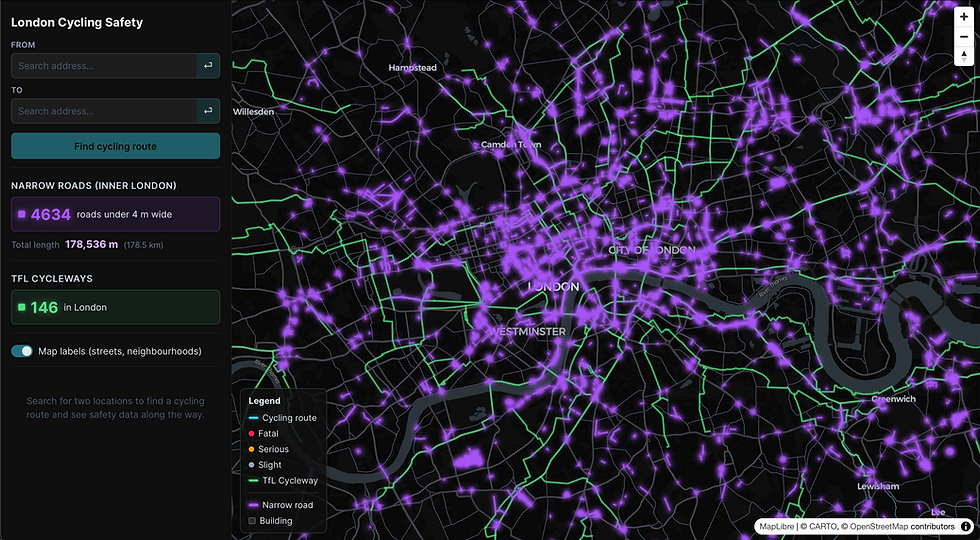
Or is it? When I analyse the paths that it picks and some of the data on the maps, it makes silly errors like thinking that an area with a bike path only is a very narrow road, where there is no risk for the cyclist, and definitely the data from TfL is a bit iffy or well, I should have worked more with it, normalising it, obviouslyy there are more cycling incidents in the most busy junctions that doesn’t mean they are effectively the unsafe choice. For a project that took me a couple of hours a weekend for over two weekends in March, it was really fun. But why I did it, apart from fun, was to understand how these tools work.


In a way, working with Cursor wasn't really like working with software engineers, because the amount of detail and context I had to provide was a lot. Sometimes, they will not understand the simplest task, but then they will be brilliant at fetching data sets for me, which I used to hate when I was working on urban analytics. Certain parts become less tedious, other parts horribly tedious. Overall, if you are a builder type who likes tinkering, these tools are fun to try. As someone who has been working with developers for the past 7 years, I prefer a process that involves them. I truly believe in the Socratic method of questioning to have the best outputs, and some developers are brilliant at asking the right questions.